National Mathematics Day: Ramanujan’s journey, a guide for future
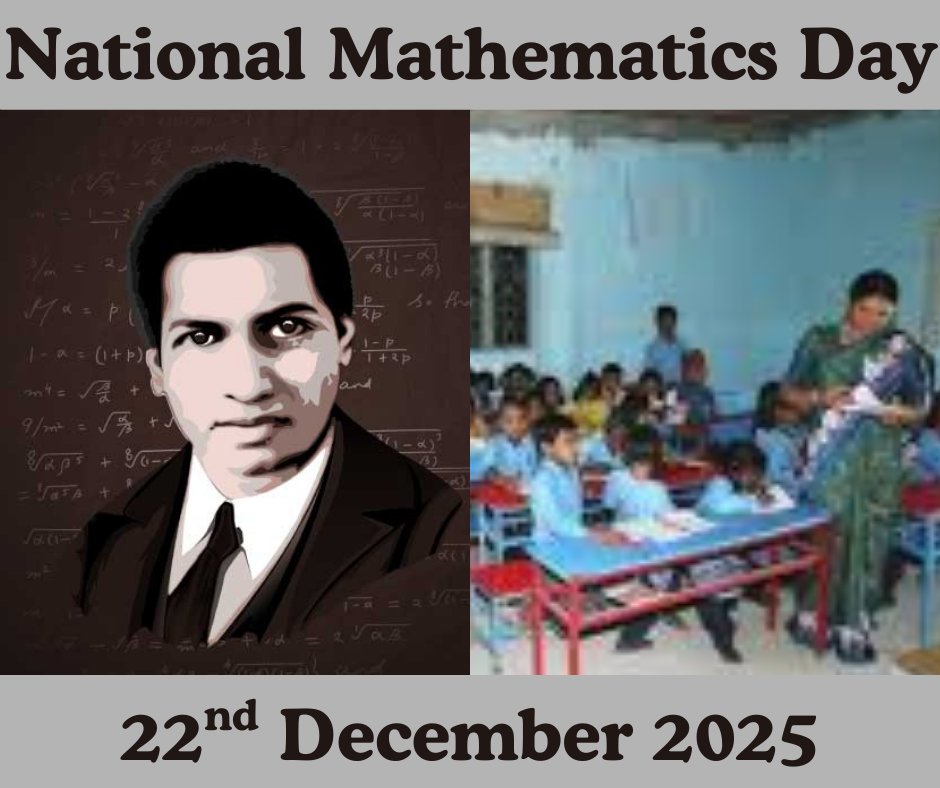
Ramanujan’s journey & it’s applications in contemporary India on the National Mathematics Day.
Every year, National Mathematics Day—December 22, is marked with talks, seminars, social media posts, and routine praise for Srinivasa Ramanujan. The intent is sincere. But the exercise often ends at celebration, not reflection. Ramanujan is remembered as a rare genius, seldom as a reminder of how poorly our systems recognise talent that does not arrive through approved channels.
A Genius Who Survived the System
Born into poverty and largely self-taught, Ramanujan’s journey did not unfold within a supportive academic environment. Institutions rejected him, scholarships fell through, and recognition came only after he left India. His genius survived in spite of the system, not because of it. That distinction matters, especially when access to quality mathematics education remains uneven and closely tied to privilege.
Mathematics: Bridge or Barrier?
In today’s India, mathematics sits in a conflicted space. It is praised as a sign of intelligence and feared as a tool of elimination. Students memorise formulas but rarely encounter curiosity. Coaching centres flourish, while classrooms struggle to inspire.
The PARAKH Rashtriya Sarvekshan (NAS), conducted with over 21 lakh students from Grades III, VI and IX across more than 74,000 schools, found that large numbers of students struggle with basic numeracy, such as identifying simple patterns, comparing whole numbers, and understanding fractions and multiples. In Class IX, nearly 63% of students were unable to spot simple patterns in numbers or handle basic numerical concepts. For Class VI, 54% could not compare whole numbers or read large numbers accurately.
These gaps reveal that even foundational mathematical understanding remains elusive for many schoolchildren across India. The subject that once gave Ramanujan freedom of thought, now unfortunately, has become a barrier to creativity and innovation.
Relevance in a Data-Driven Age
The irony deepens in an age shaped by data, algorithms, and artificial intelligence. Mathematical thinking drives public policy, finance and digital systems, yet mathematical literacy remains weak, and research ecosystems fragile. We celebrate results, not the conditions that make discovery possible.
A True Honour
Ramanujan’s notebooks show that mathematics is not just technique but imagination guided by logic. Moreover, he chased solutions not validation. National Mathematics Day would carry more meaning if it asked harder questions: How many Ramanujans go unnoticed? How many are lost to rigid curricula, language barriers, or economic limits?
To honour Ramanujan is not to glorify struggle, but to ensure that brilliance no longer has to fight neglect to be seen.