Defense Against Whom? — On Hindu Raksha Dal’s Act In Ghaziabad
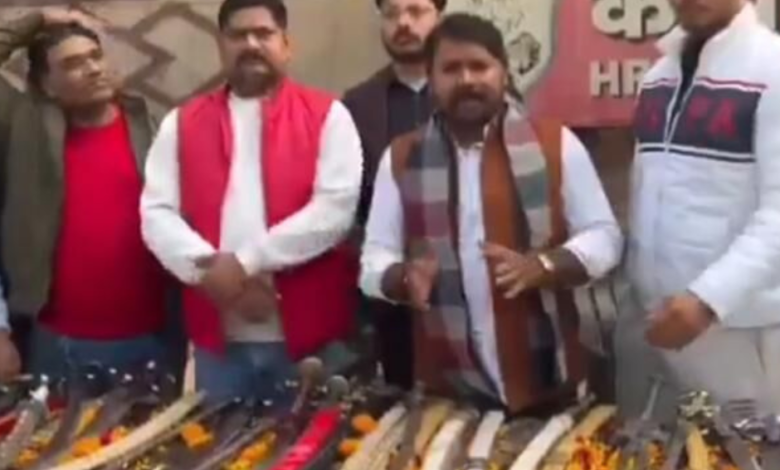
On December 29, 2025, Ghaziabad police registered a case after a video went viral showing members of the Hindu Raksha Dal (HRD) distributing swords and other weapons in Shalimar Garden Colony, Uttar Pradesh.
The recent arrests in Ghaziabad over the public distribution of swords by members linked to the Hindu Raksha Dal are not merely a law-and-order matter. They point to a deeper unease in how fear, identity, and public space are increasingly being expressed.
Videos of swords being handed out in a residential area unsettled many, not because such acts are unheard of, but because they are becoming familiar. What was once confined to the margins now appears openly, often justified as self-defence or cultural assertion. That shift itself deserves attention.
The issue is not only the act, but the message it sends. A sword in public is not symbolic speech; it is a signal. It changes the atmosphere of a place. It normalises the idea that protection comes through visible force rather than institutions, trust, or restraint.
Groups involved in such displays often frame them as responses to perceived threats. But intention cannot override consequence. When weapons are introduced into civilian spaces, they invite escalation, not safety. The language of protection quickly blurs into provocation.
What makes incidents like this possible is a wider environment that rewards spectacle. Social media circulation, selective outrage, and blurred lines between legality and legitimacy create space for such actions to appear defensible. By the time questions are raised, the image has already travelled.
The Ghaziabad episode should not be treated as an isolated case or reduced to a handful of arrests. It should prompt a larger reflection on how easily symbols of violence are being folded into everyday political and cultural expression.