Delusional Triumph: On Trump as Venezuela “Acting President”
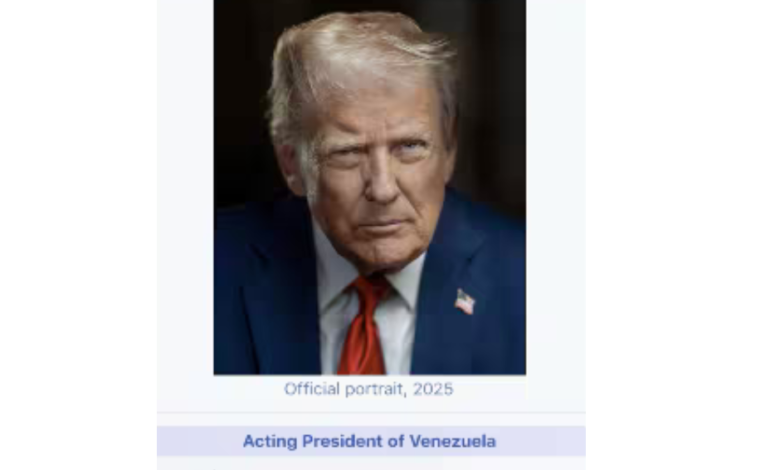
A few days after a high-stakes military operation in Venezuela, a new moment caught global attention — not for its legality, but for its tone. On January 12, 2026, U.S. President Donald Trump posted an edited image on Truth Social portraying himself as the “Acting President of Venezuela, Incumbent January 2026.” The image, styled like a Wikipedia profile, listed him as both the 45th and 47th President of the United States and the leader of another country. No official record backs that designation, and no government has recognised it.
This post did not happen in isolation. It followed a U.S. military operation in early January during which Venezuelan President Nicolás Maduro and his wife, Cilia Flores, were captured in Caracas and taken to New York to face charges. Maduro has pleaded not guilty in federal court. Meanwhile, inside Venezuela, the Supreme Tribunal of Justice swore in Delcy Rodríguez, the former vice-president and oil minister, as interim president to maintain continuity.
Against that backdrop, the social-media image is striking not because it is new, but because it shows how symbols are used in politics today. A title that does not exist in law or constitution can still travel quickly online, shaping reactions and interpretations. People sharing and debating such a post reveals how easily perception can detach from formal reality.
ALSO READ: Conviction Crisis: On U.S. Exiting 60+ Climate Conventions
It matters because politics lives not only in constitutions and agreements but in communication — in the pictures we circulate, the phrases we repeat and the assumptions we make. A digitally altered profile does not make someone the head of a foreign state. It does, however, reflect how narratives are being constructed and absorbed in an age where social media and leadership blur into one another.
What should give pause is not the claim itself. It is how quickly such claims can be taken seriously, shared widely, and treated as part of unfolding world affairs, even when they contradict recognised facts about leadership and sovereignty. When titles become clickable headlines, the line between what is legally true and what feels believable online gets thinner — and that is worth noticing.
References: